Arrived in Busan International ferry terminal after an uneventful crossing. Apparently there was a thunder storm, but one of us slept through untroubled and the sea was calm. Immigration was quick and painless and queue-free. Walking out into South Korea for the first time it was cloudy, grey, and with a little drizzle starting – but nowhere near Tokyo’s wind and deluge on arrival, although perhaps there’s a theme developing here? A ten minute walk got us into the station; money drawn; sim card fitted; breakfast had. It was actually a bit more involved than it sounds, but within two hours or so we were on a bus to Gwangalli – home for the next three nights.
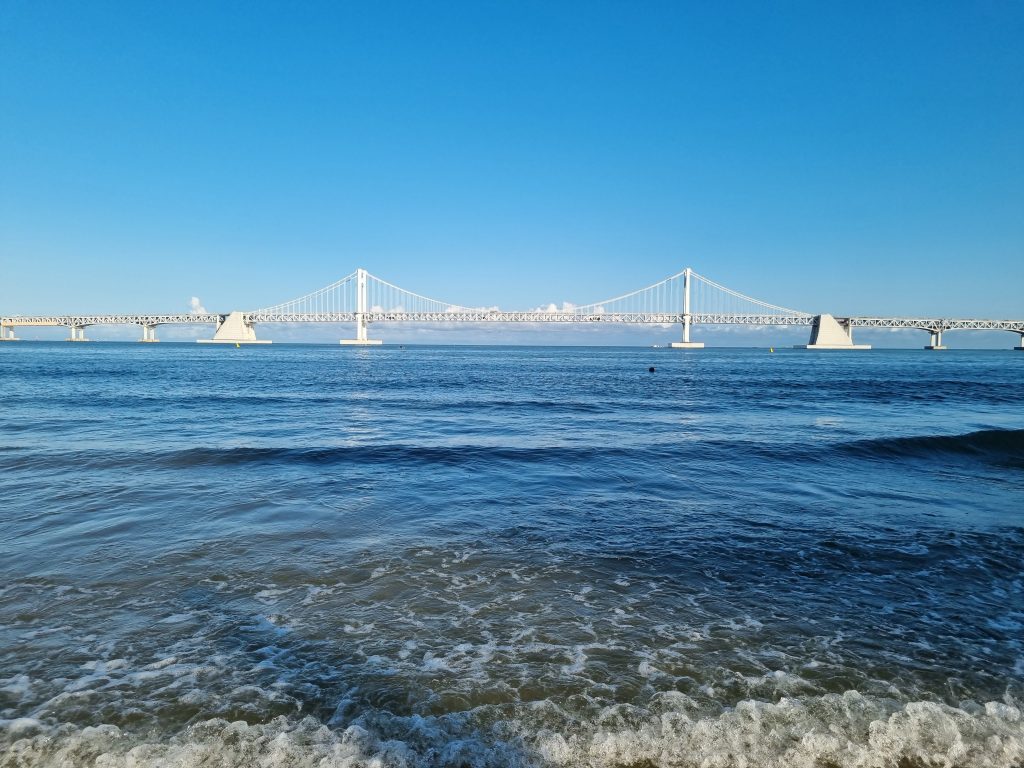
Wow! What an amazing beach front. A long golden beach, azure sea framed by a massive bridge crossing the bay. The sea front runs to the northwest and around into the river, and some amazing looking buildings and infrastructure – so very different to the UK seaside.

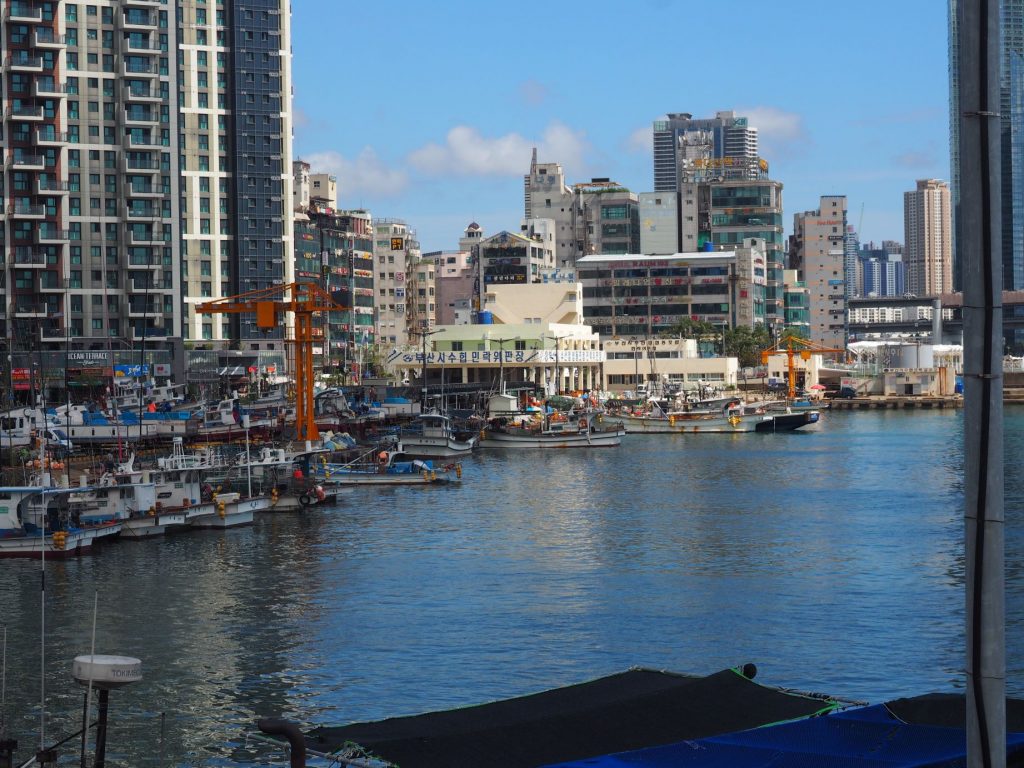
But amazingly modern buildings sit cheek by jowl with the old fishing harbour
We seem to have scored with the accommodation – 4th floor beachfront apartment all mod cons. A bit different from the hostel of a few nights ago.
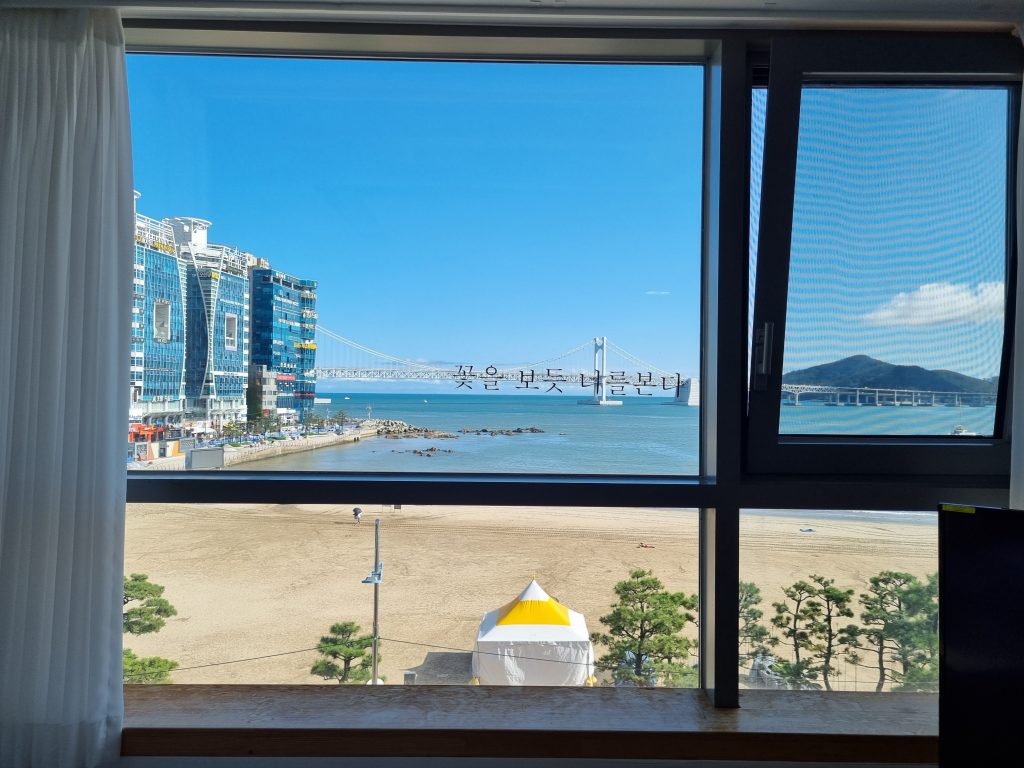
We decided Busan was going to be more chilled out (ha ha) as Japan had been pretty full on. First morning was a stroll on the beach, a dip in the East Sea (a first), and a bit of planning.
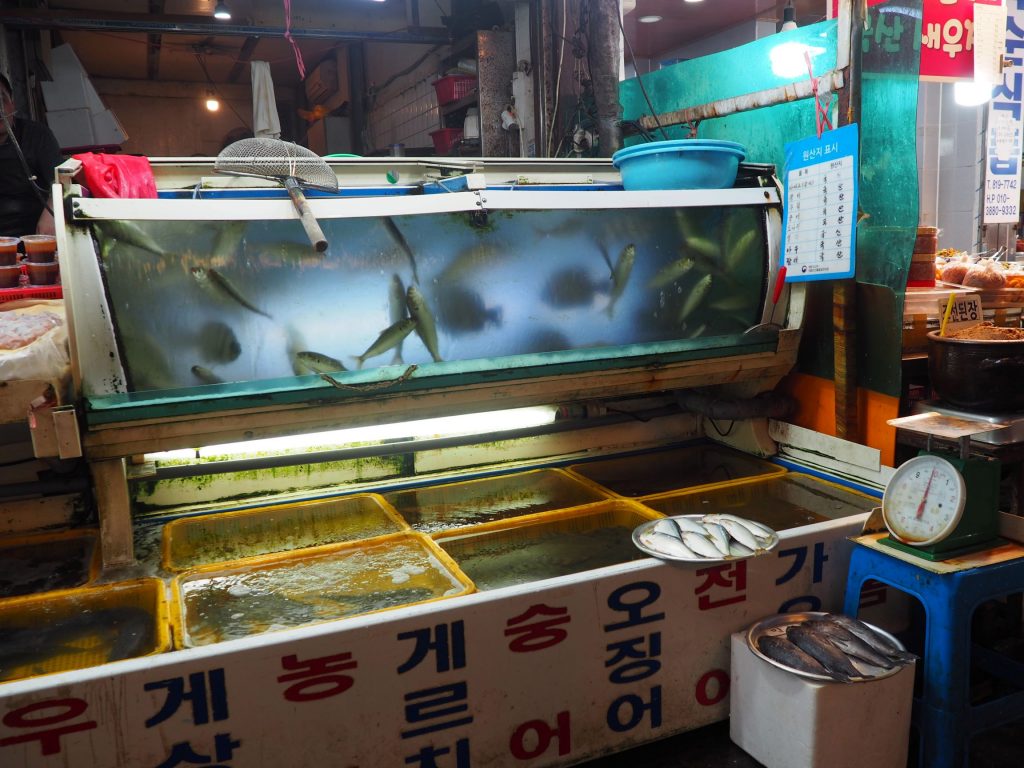
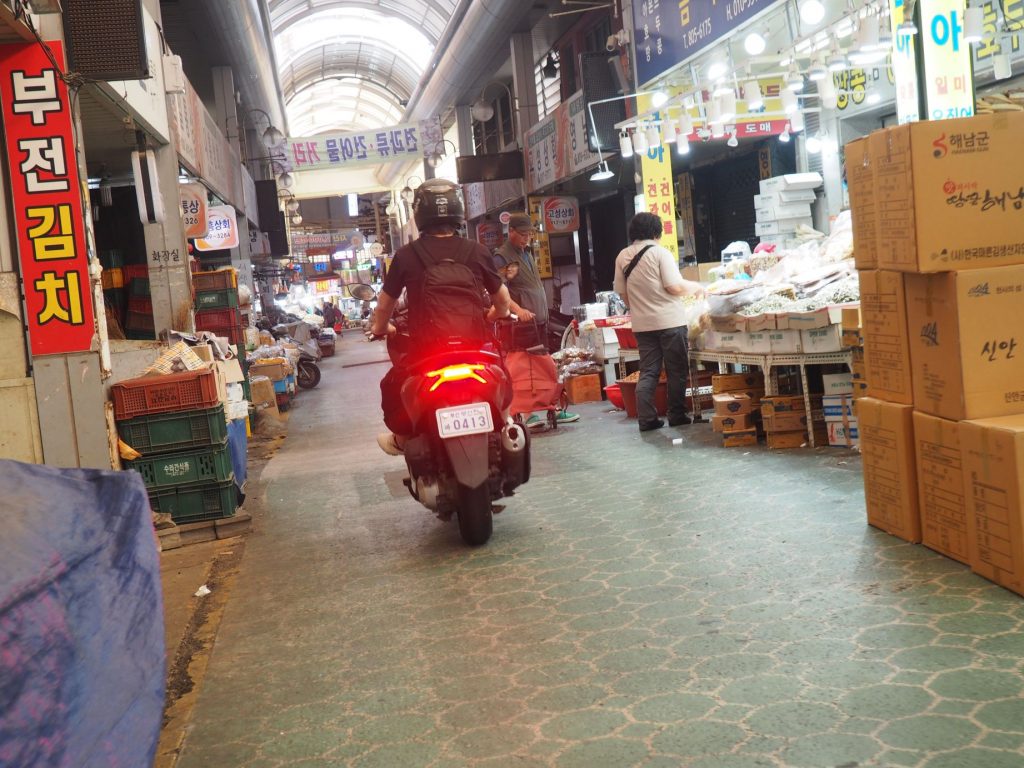
The transport here is really easy to use and really cheap – a set price for any journey, no matter how far. So, the afternoon was a ‘let’s pick a random bus’ time. We ended up at Bujeon Market – a huge and amazing food market – this was the SE Asia we remembered from Thailand and Hong Kong – masses of seafood (some still alive and in tanks), vegetables, pulses, meat, sweet things, street food – crowded and pungent.

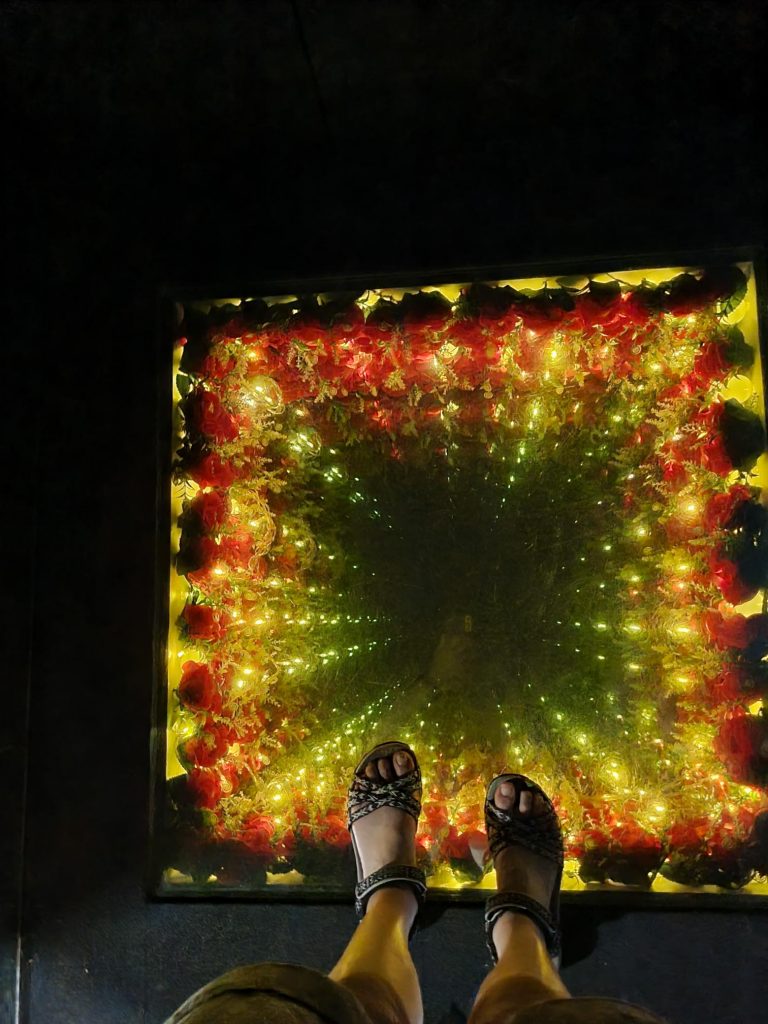
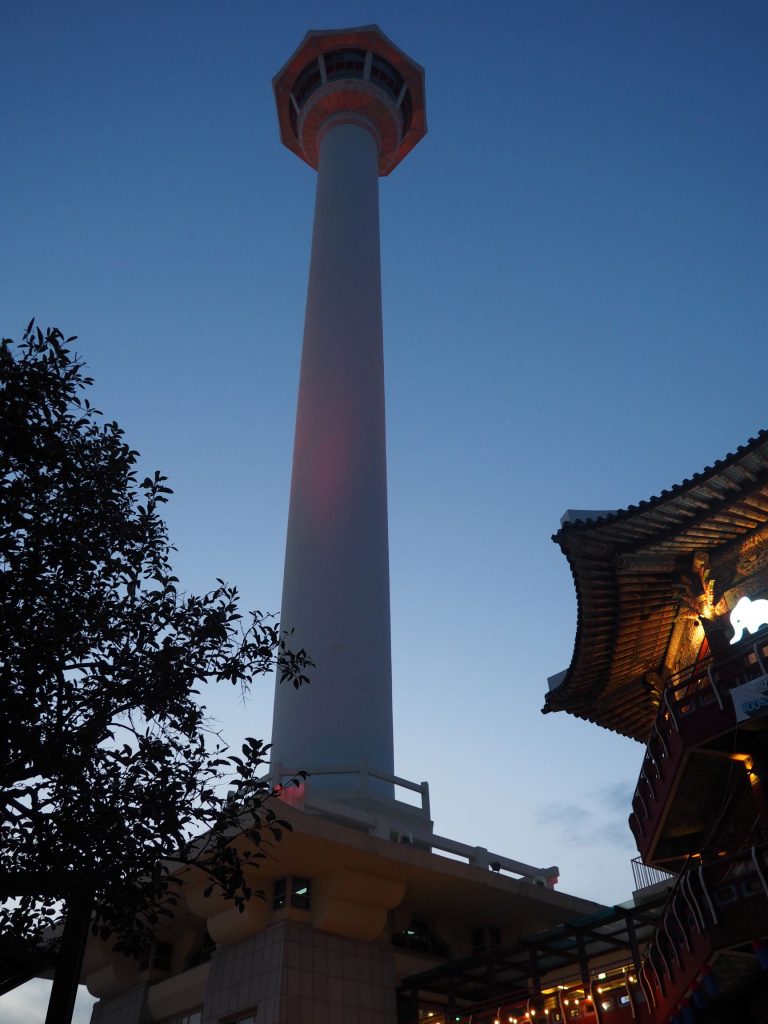
Evening saw us at the Diamond Tower – Busan’s highest viewpoint. A very surreal trip through a psychedelic Korean-style competition. A fun evening – finished off with beach front bar for dinner.
Our second full day in Busan involved a run on the beach front early in the morning….
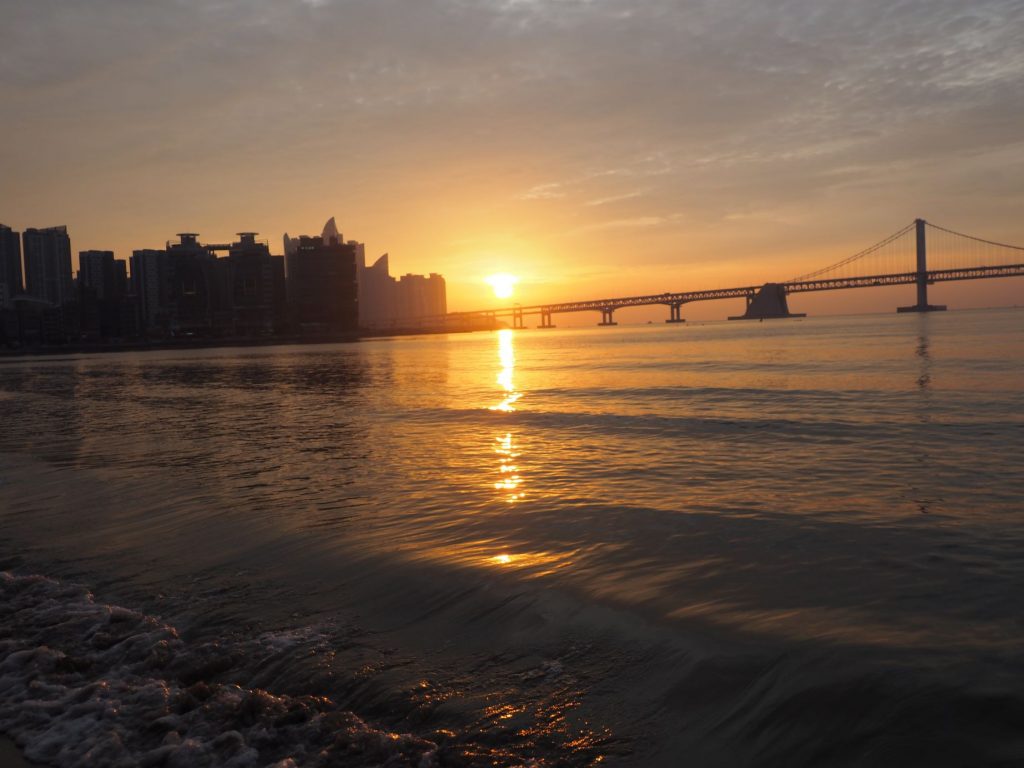
…which was very well frequented by locals jogging or walking along the edge of the water, and then, after a bit more planning, a trip – via the bus, of course – to the ’40 Step Culture and Tourist Street’ followed by another bus journey to Gamcheong Cultural Village. The former was a set of steps around which refugees from the 1950-53 Korean war congregated and created a community – starting out being regarded as a “slum area”, creating a life for themselves and building and improving the area over time.
A visit to the Memorial Hall helped with the history and understanding of the background and was illuminating, if a little scant on directly understandable information, being all in Korean – however – a picture paints a thousand words!
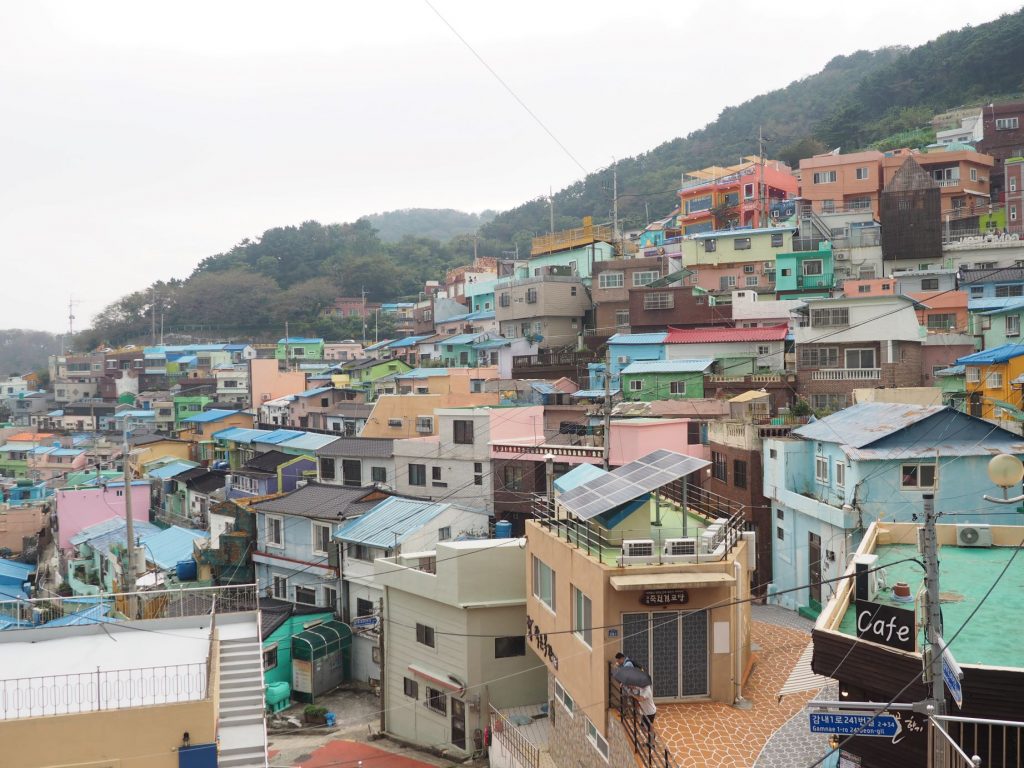
The visit to the Cultural village was a similar theme – a whole community set up to support itself and build housing that harmoniously blended (colourfully) with it’s surroundings. A very artistic and bohemian area and incredibly steep roads, stairways and streets which would never be allowed in a western world! Each building was painted a different colour and it was all a delight to behold and a refreshing change from the hub-bub of the city which surrounded it. It’s now a thriving tourist attraction and a a bit of an artists’ hotspot.

Rain stopped play and we headed back to our apartment to pack and get ready for a bus journey (hopefully) in the morning to our next stop on our journey in South Korea – Mokpo.
MOKPO
Arrived after coach journey of 6 hours which had originay thought was 4 after doing lots of web research. An interesting experience which has taught us not to rely too heavily on websites even though one was an official KO websites! Scenery was very lovely though and it was interesting to see some smaller towns and even smaller villages as the coach stopped pretty much everywhere, except for a loo break after the first one which had been an hour or so after the journey started – we were very happy to get to Mokpo!
Next step was to understand the buses (no metro to worry about). We realised that Roman Scrip is much less used in Mokpo. Good old Google tranlate to the rescue! Local bus was easy to use though and we arrived safely at our digs – The One Hundred Year Hanok.
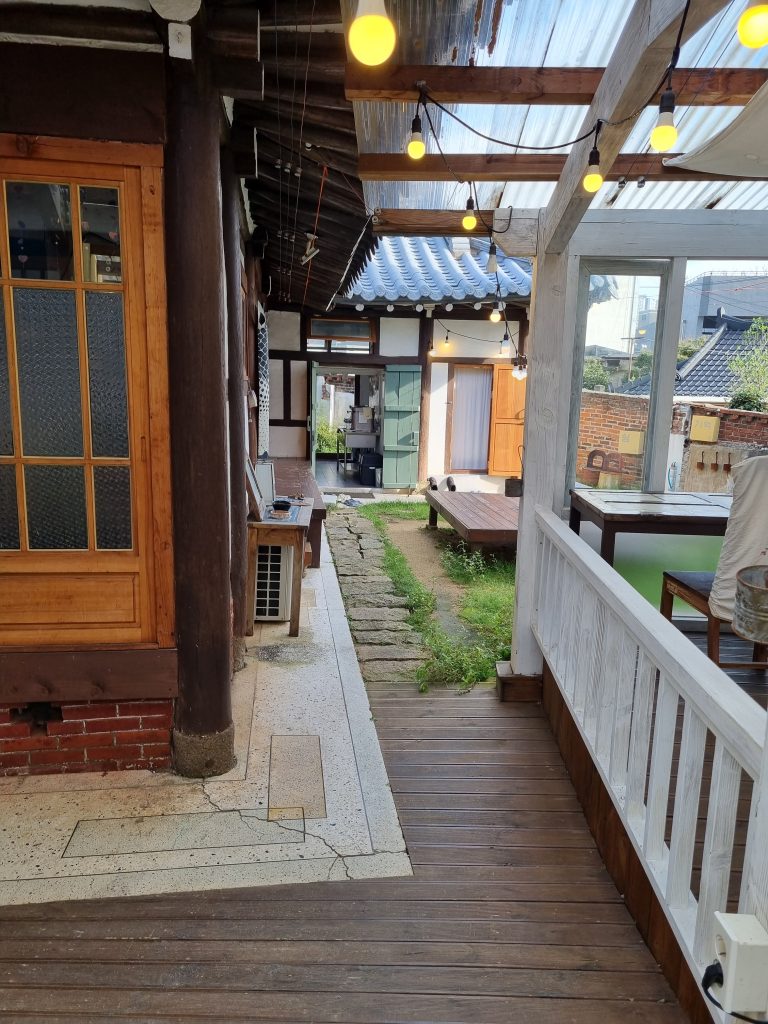
It was a very traditional Korean house converted to a guest house. Futon mattresses (really comfy) in our room and no shoes of course – quite similar to Japanese accommodation but normal tables and chairs in the communal eating area. It was really lovely and very peaceful.
Met a really nice girl, Rosa, from the Netherlands and went out for dinner that night with her to swap stories of our travels.
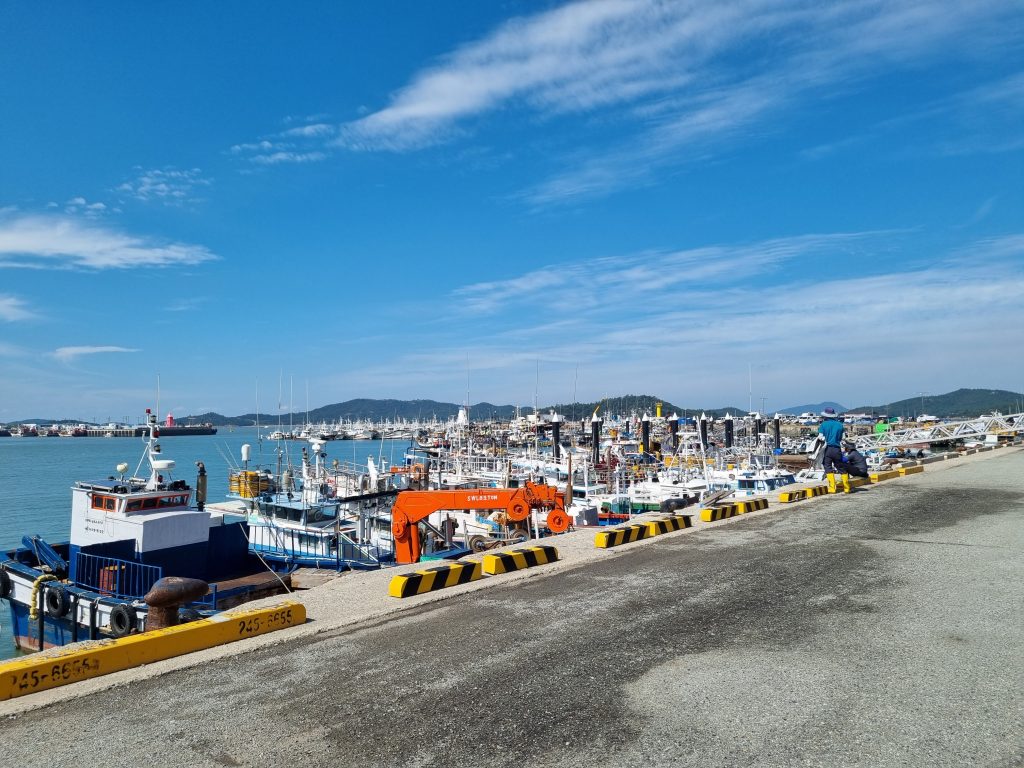
With only one full day in Mokpo and aware that Seoul was another enormous city like Busan, we decided to go more rural and headed for Buk Harbour to see what a working harbour was like.
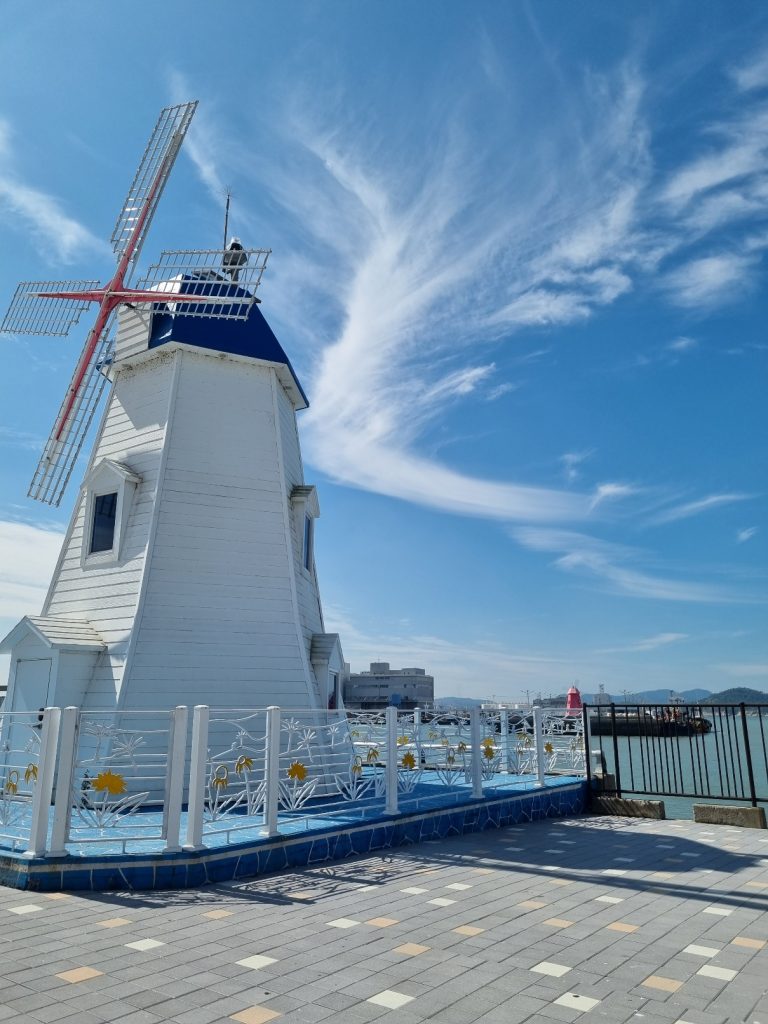
The two windmills (green is blue in Korea apparently) marked the harbour entrance.
Another reason for this choice was to see the Mokpo Bridge which is 3km long and architecturally impressive.

After exploring the docks (another theme developing?) We headed off to catch a cable car, yup, another, to Gohado Island.
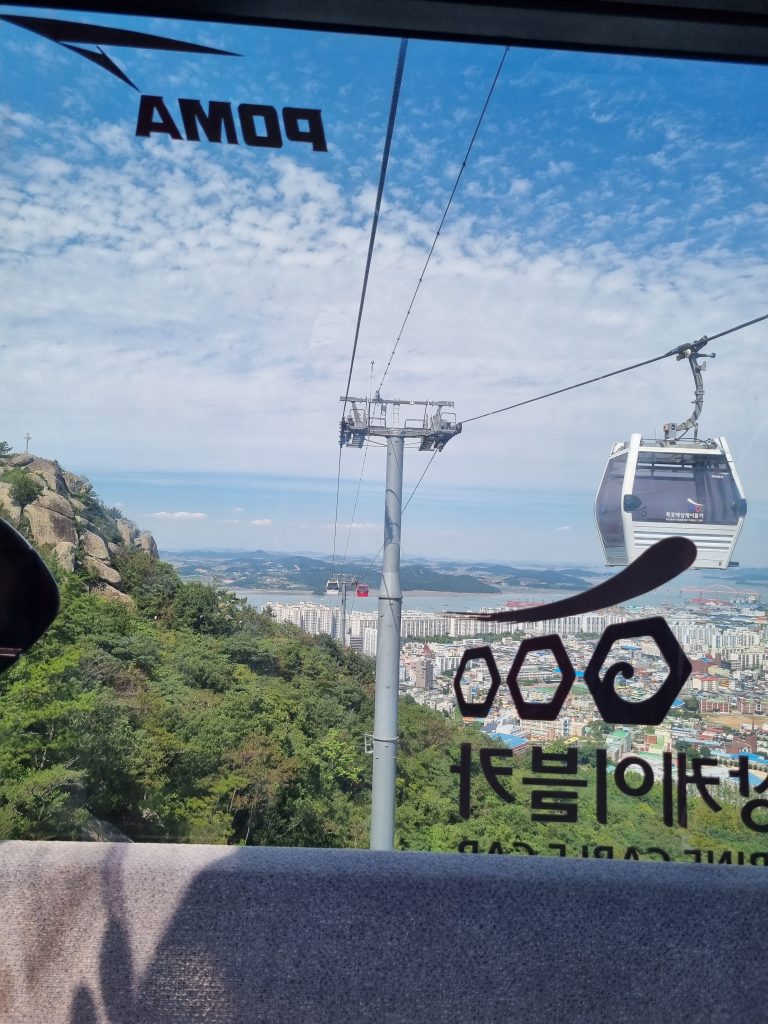
At 3.23km long and 155m high it is the longest and highest cable car in Korea and gave some pretty awesome views of Mokpo and the Yudalsan Sea (the West Sea), and of course, the bridge.
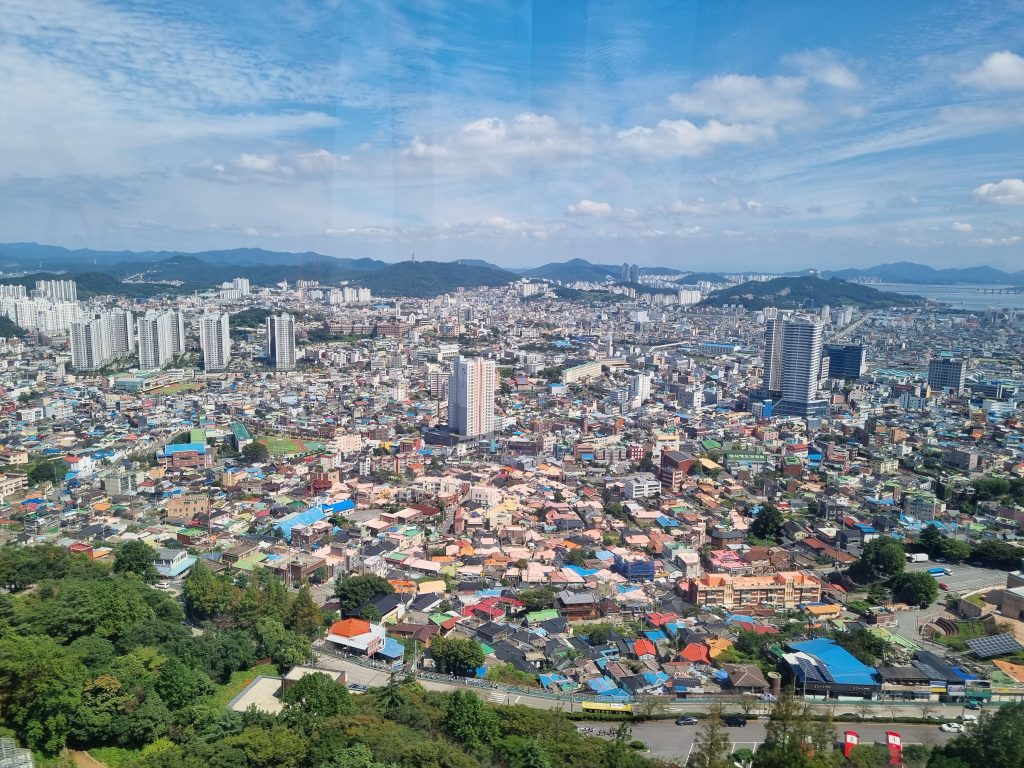

Gohado Island is quite small and after a little exploration we discovered a hiking trail which was very off the beaten track so very quiet and we met a very surprising creature.
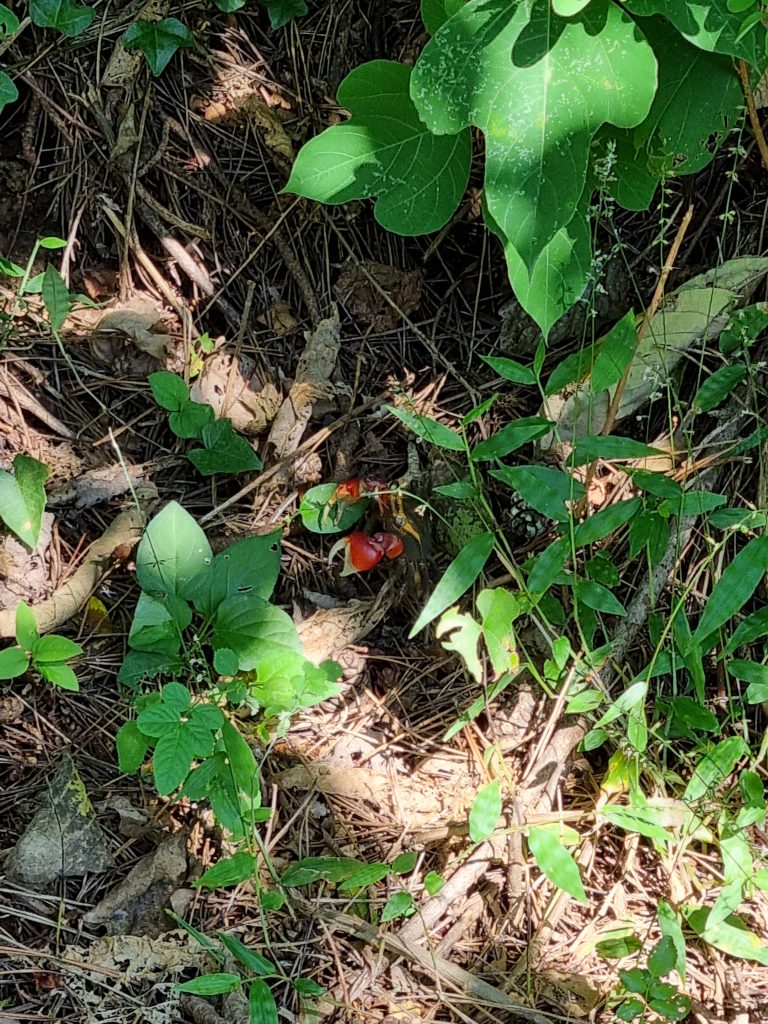
Not really sure which of us was the more surprised but it was definitely very odd to see this very vibrant (and thankfully quite small) crab on a footpath high on a hill and no-where near the sea! We saw another later on too as well as an abundance of butterflies. All in all it was a fabulous trek which took us to the end of the island and then a walk back along a boardwalk to the cable car again where ice cream was very much enjoyed, including th Mugwort Icecream – greeny blue and tasted a little bit like lemon verbena.

After a nice evening trying to work out a local menu and a good night’s sleep, we headed off to catch a train to Seoul. Another new learning point – might be worth getting the ticket in advance sometimes as they were sold out for the train we wanted. However, after a bit of a muddled up discussion with a very nice man in the ticket office, we managed to get a train which left a bit earlier and arrives in Seoul an hour earlier, despite having to change. Someone commented to us on some of the unexpected similarities between South Korea and UK; the train was packed and arrived 30 mins late, so yes, definite similarities!
Arriving in Seoul Yongsan station – not raining, so no zorb appearance, we walked the 3km to our apartment. Fantastic location, but the flat is a bit tired – very student accommodation – cheap and cheerful! But everything works, and its a very quick walk to transport links, and so it is home for the next 7 nights.
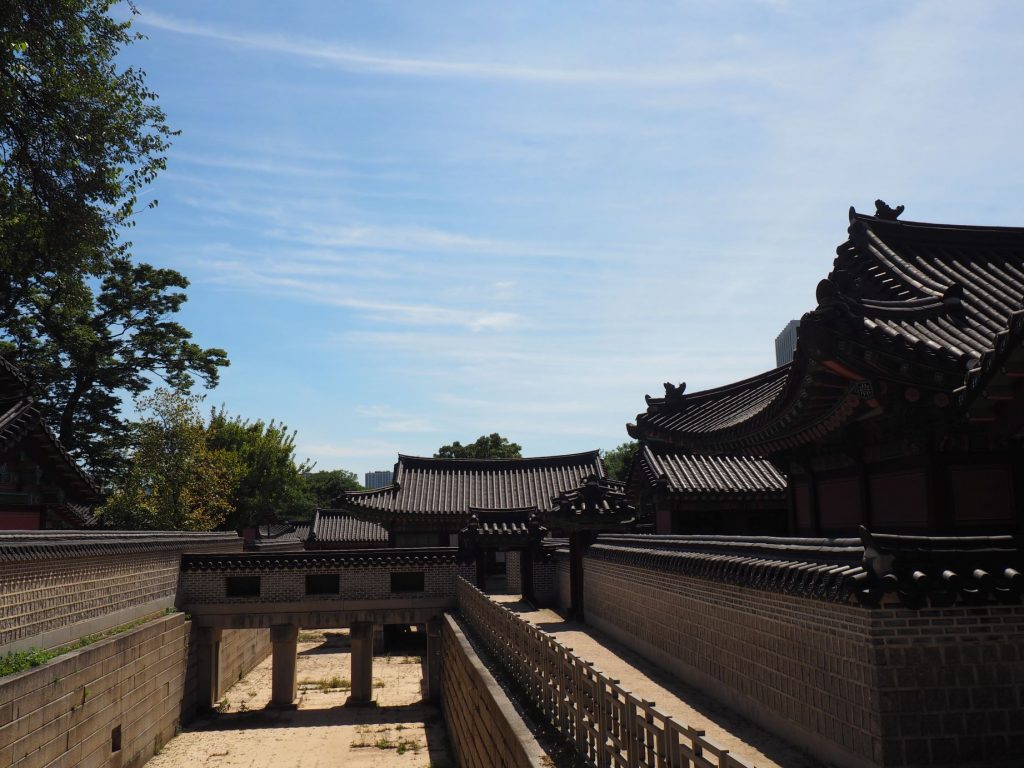
First full day was a visit to Changdeokgung Palace – a UNESCO world heritage site – and a wonderful oasis of peace in the city.

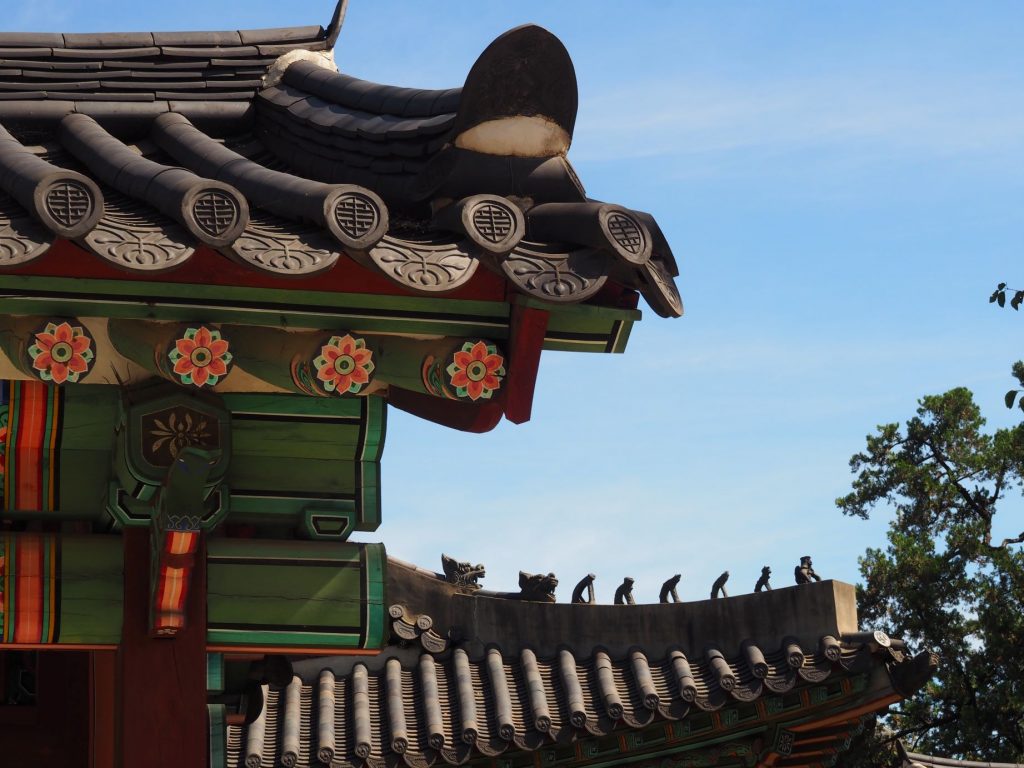
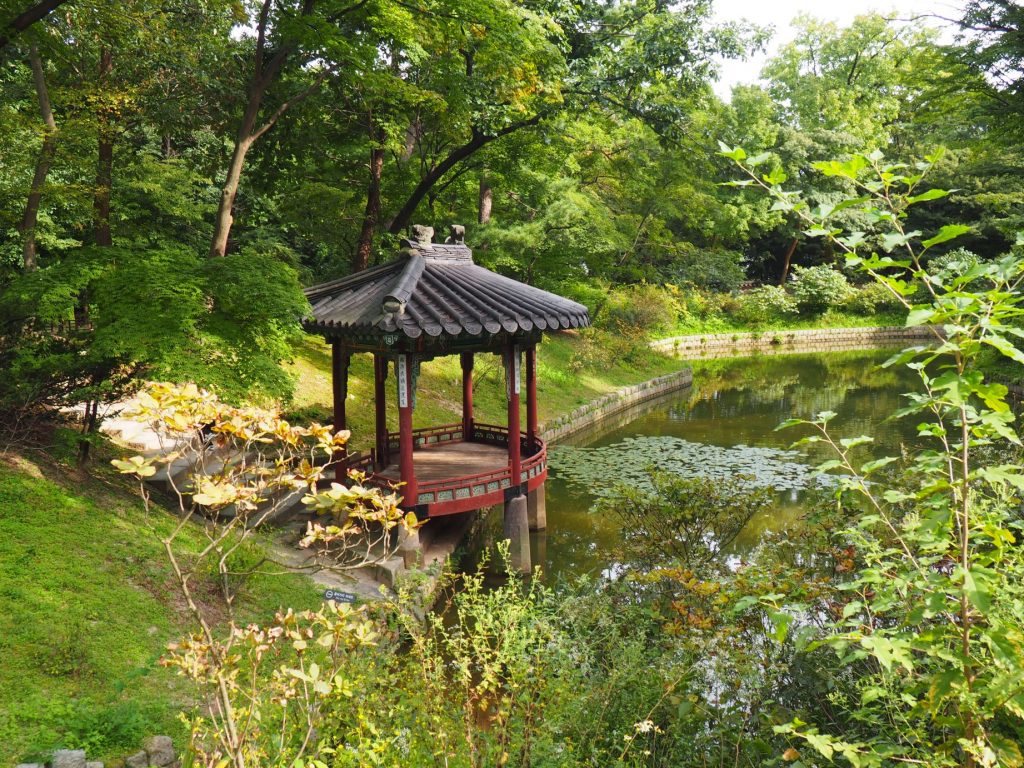
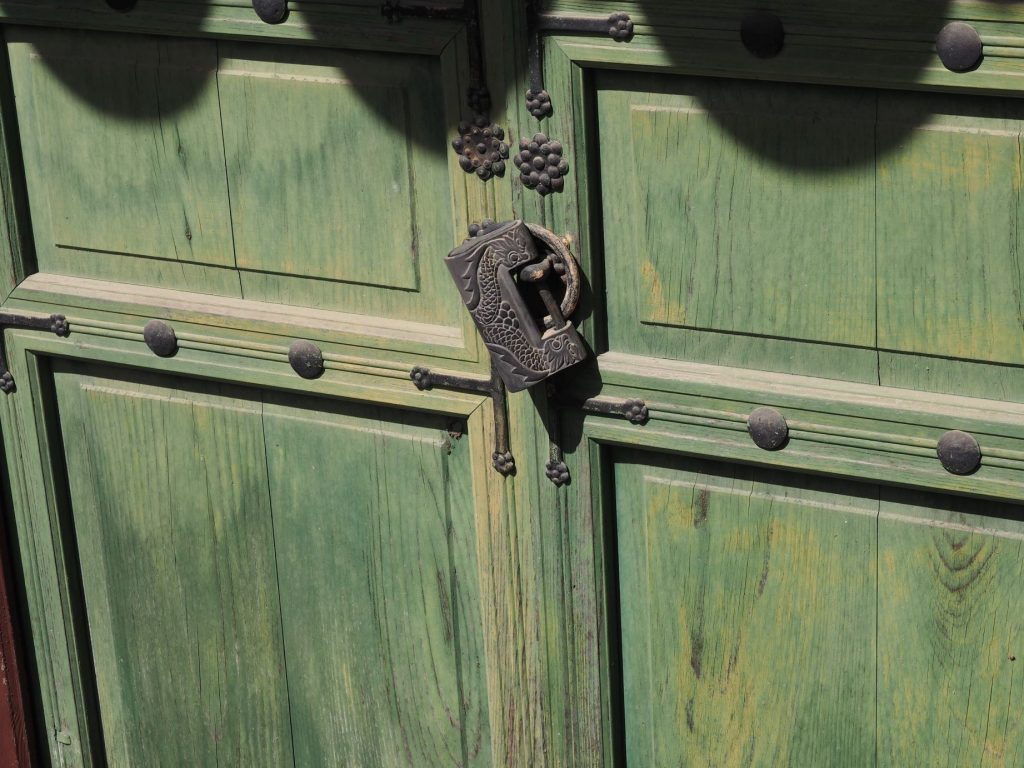
After the hit of culture, it was time to get a feel for how big this city is, so we headed towards the highest point in the city – N Seoul Tower. It’s very tall, but cheats a bit by being on top of a very large hill. With many many steps. However, the views from the base of the tower are amazing and very pretty as the sun goes down – below looking north.
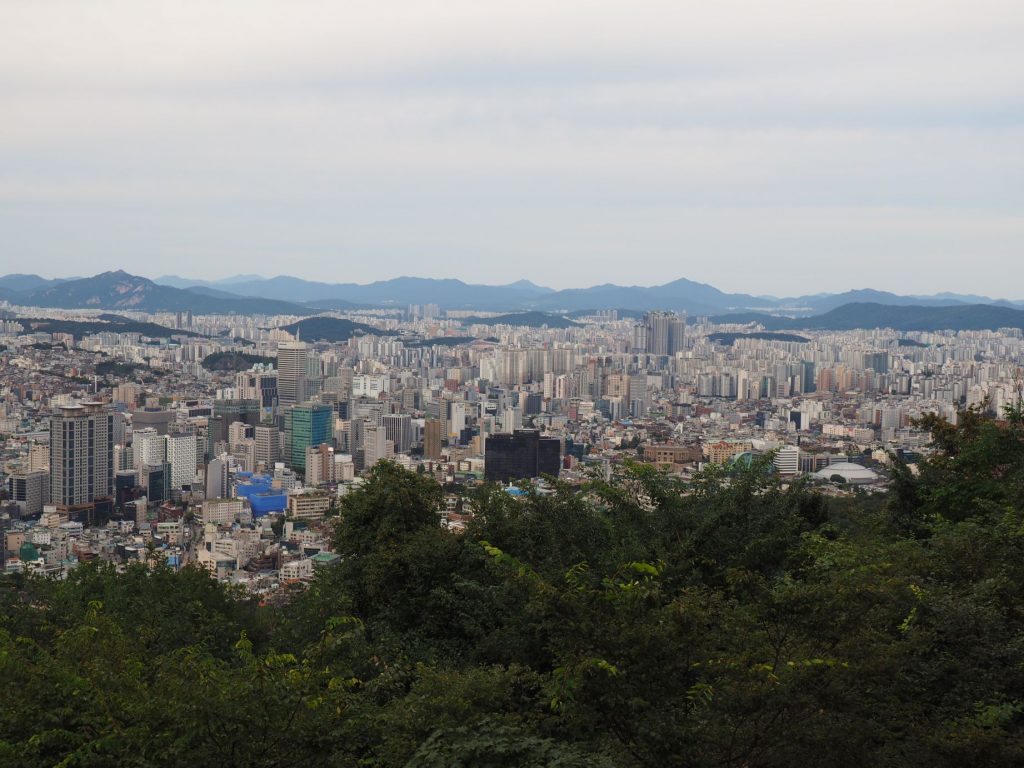

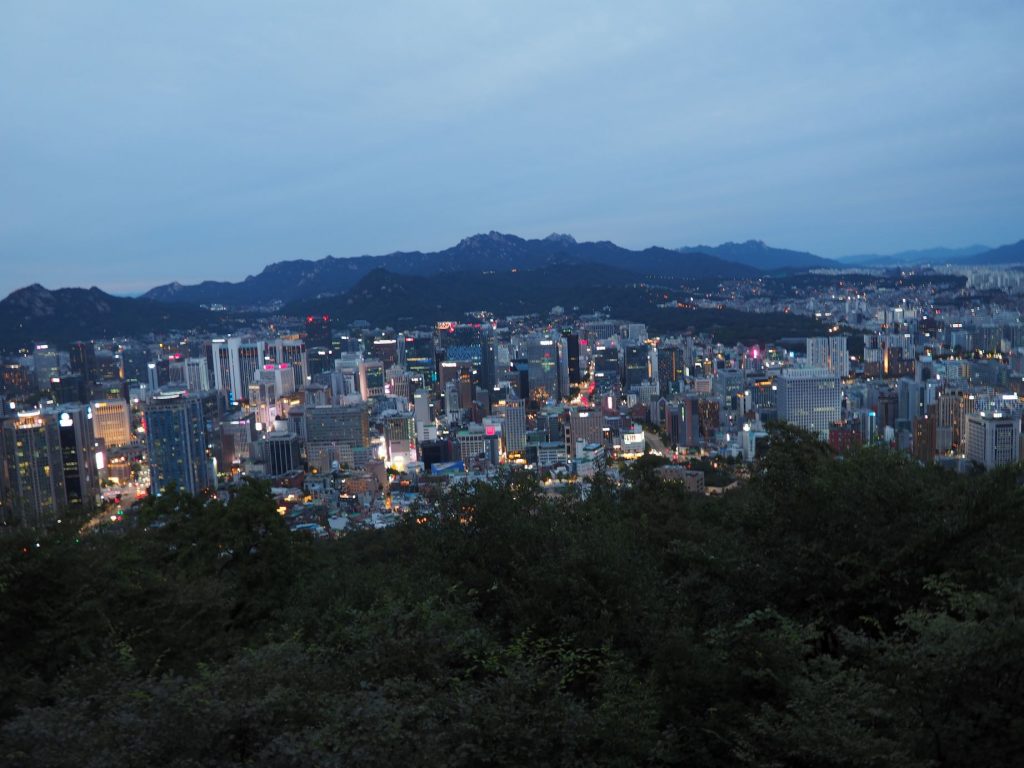
On heading up to the tower we had spotted a cable car which could have taken us up there. However, we broke with tradition and headed for the stairs – many stairs. On the way up, a couple very kindly gave us their cable car ticket for the return leg, as they had decided to walk down – it was so generous and we really appreciated the ride down to speed us to yet another delicious try out of Korean food.
The day after doing the N Seoul Tower was definitely more laid back. A long walk down to and then along the Han river, led to a chance encounter with an elderly Korean gentleman, who discussed with us the philosophy of religion, politics, the British Empire and the UK’s current standing in the world, and the lack of crime in Korea – all in the space of about 45 minutes. It was interesting but a bit surreal. On crossing the river – heading into into “Gangnam” territory – we pondered what depth the river actually could get to, given how it wide it is…

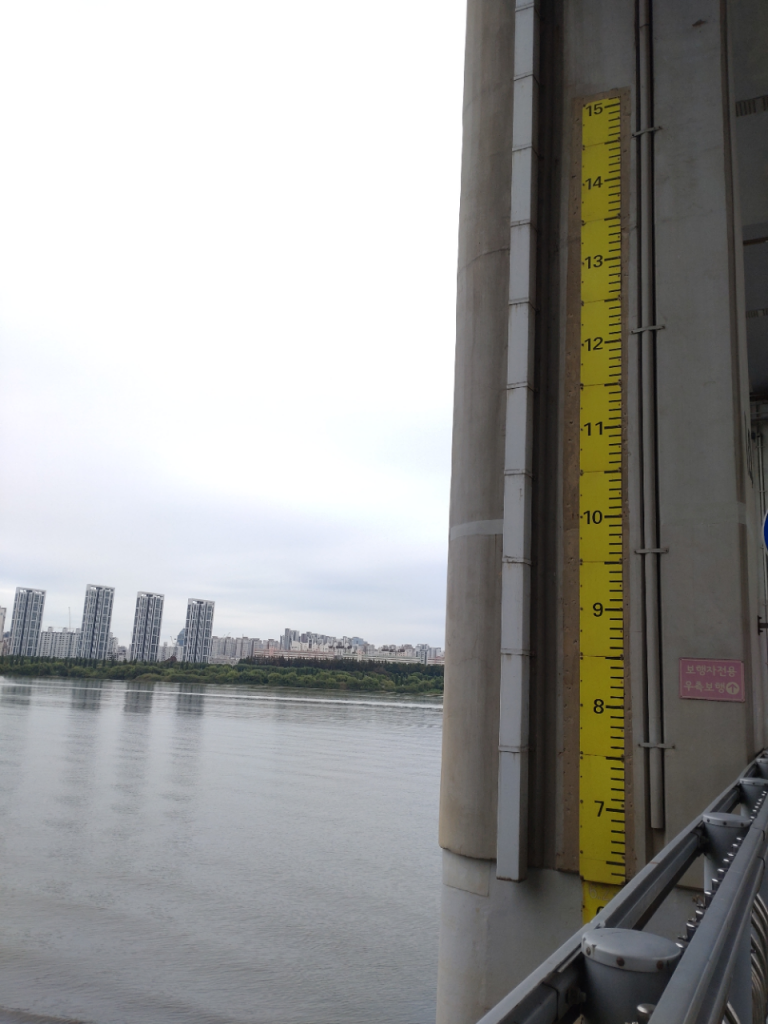
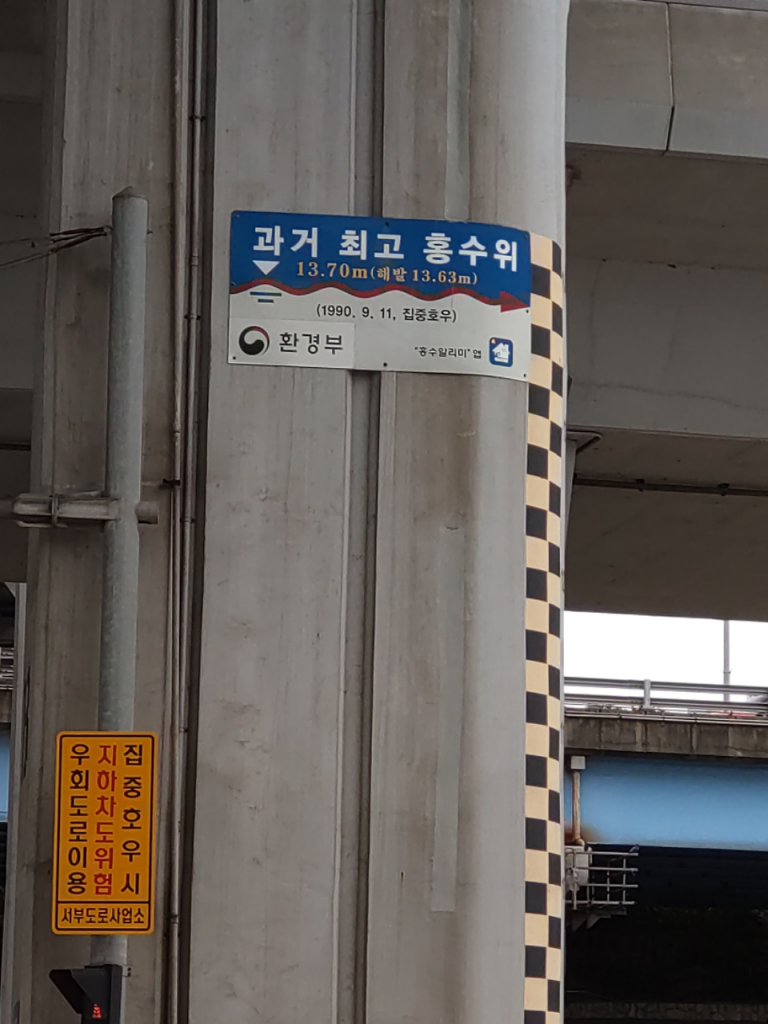
Pretty deep!
Today has been a bit more educational – a tour to the DMZ! First stop after the 7am start was a visit to the Freedom Bridge (two of them – one being a road bridge where they exchanged prisoners of war in 1953 at the end of the Korean War and the other being a rail bridge built 2006 to allow South Koreans to finally visit their families left in North Korea). We then went to the 3rd Tunnel, which allegedly (because they deny it emphatically) was one of many (4 discovered so far) built by North Korea to invade South Korea. No photos allowed inside but a rather bizarre feeling of being in a theme park where some parts of it had been recreated for photos!
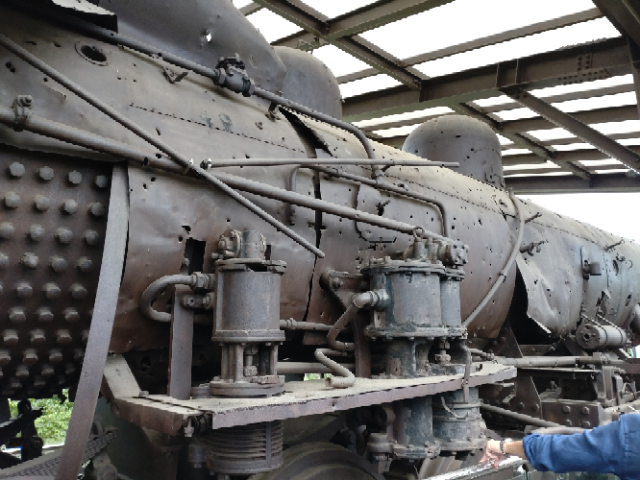
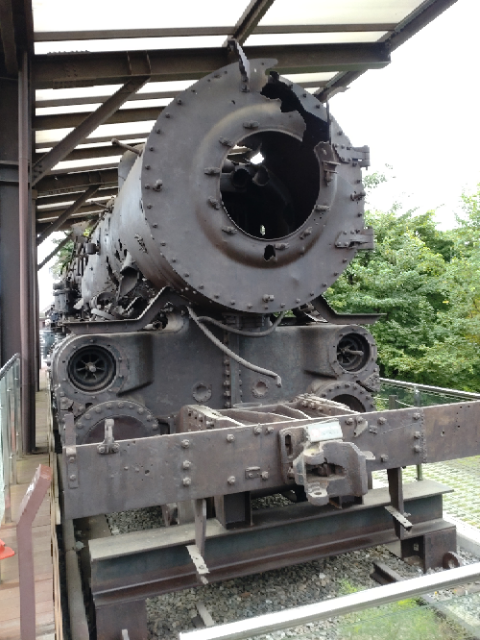
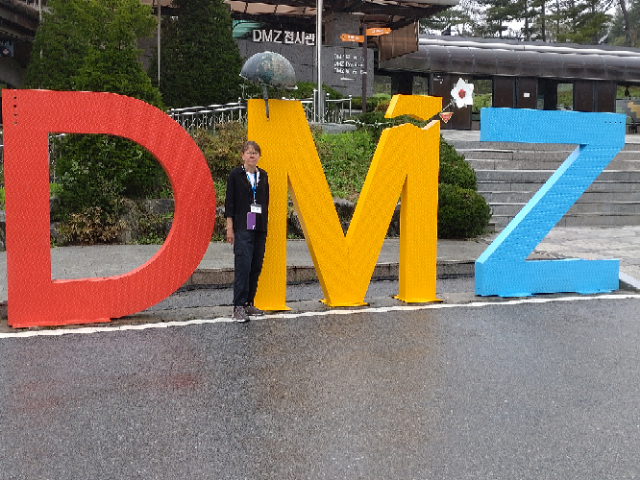
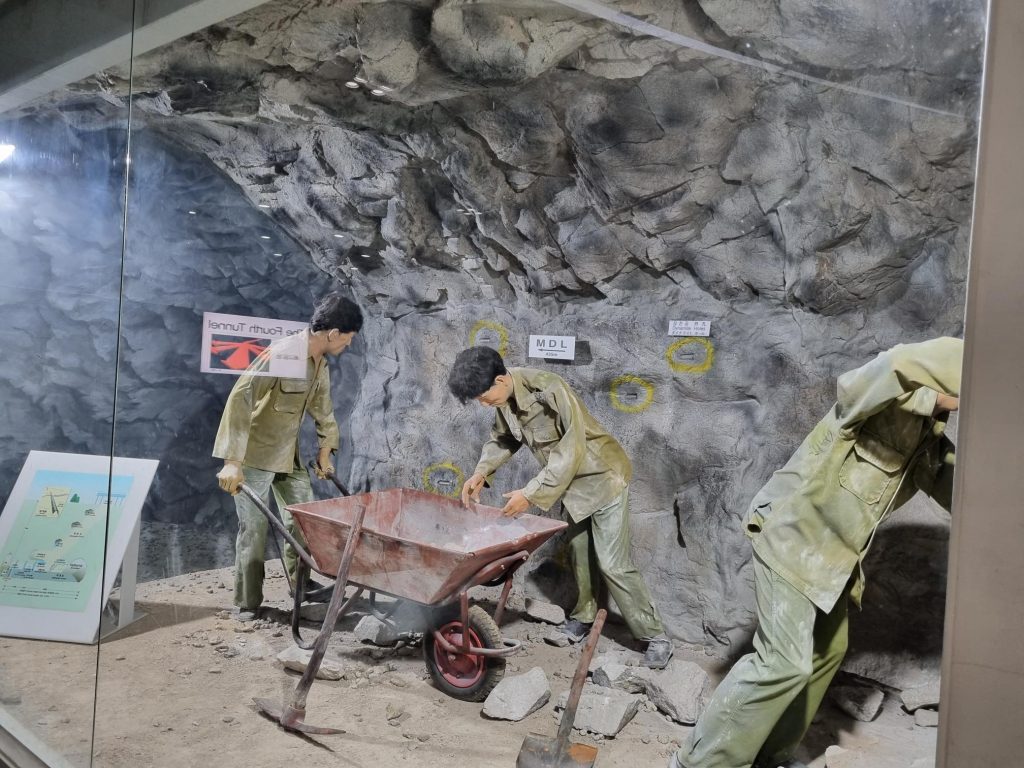
The loco was genuine and riddled with bullet holes from the war – rather sobering.
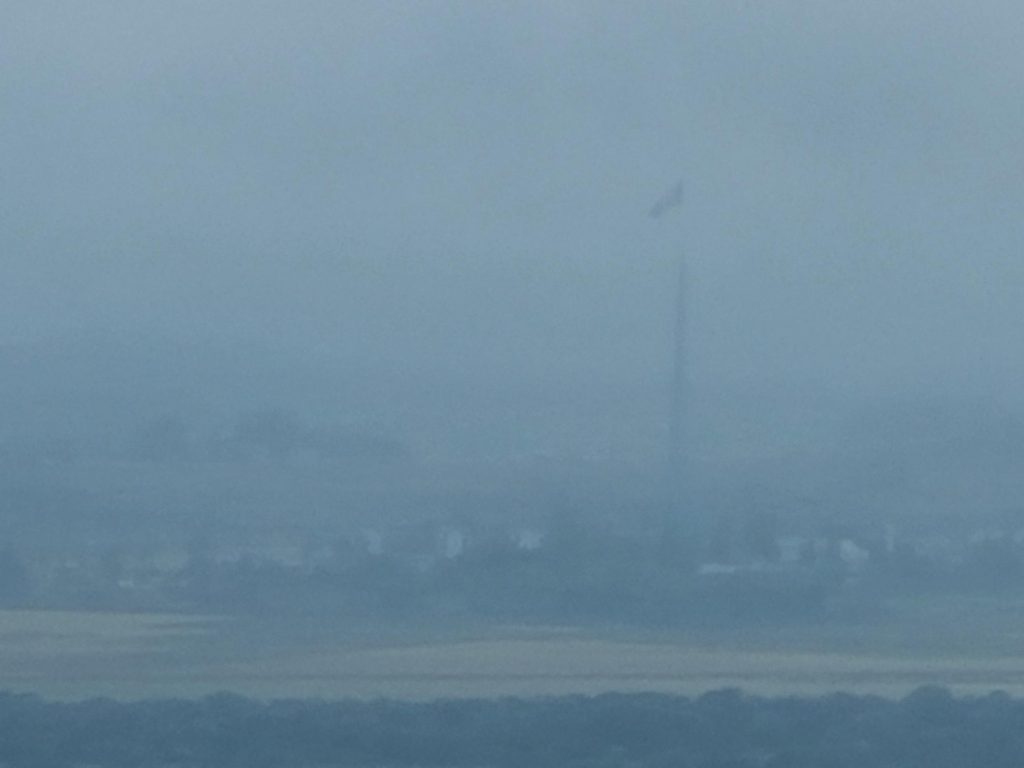
We then taken to a viewing point on Mount Dora to see into North Korea. Sadly, following our usual weather theme, cloud was low so it was a long wait for the visibility to improve so we could vaguely make out the only two villages allowed in the DMZ – one North, the other South. Both have large flag poles displaying their national flags. After the South put up theirs, the North built a taller one, so the South put in an even taller one and again the South made a taller one so the North finished the competition with a 160m pole!
Difficult to see, but you might be able to make them out:
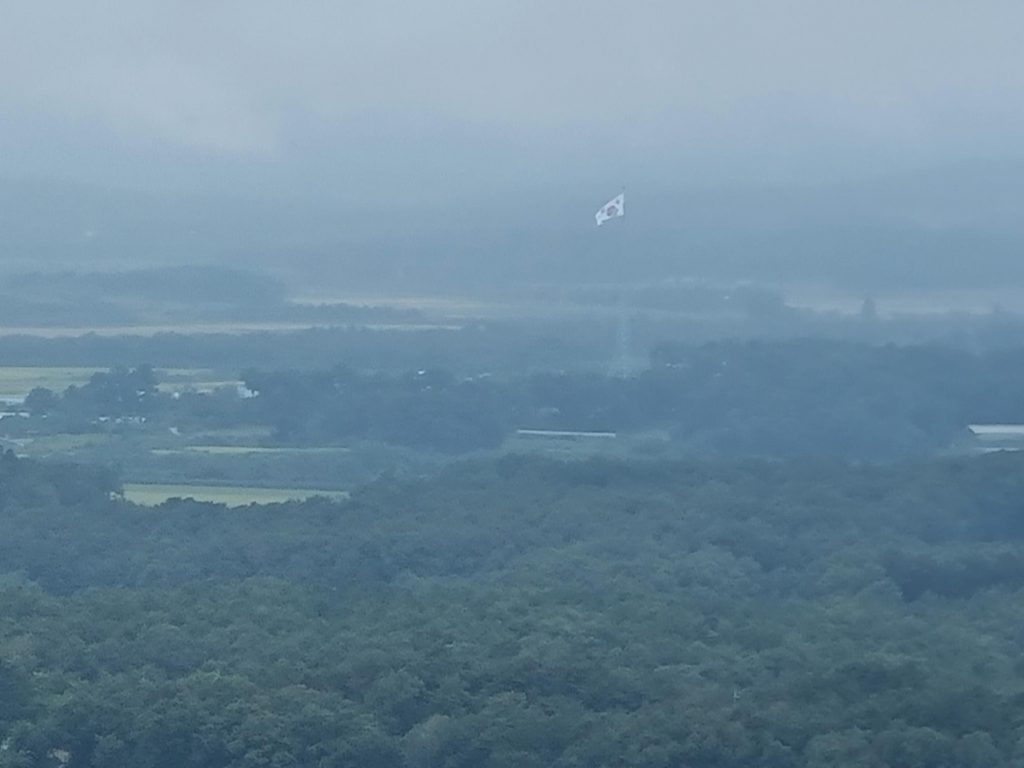
The afternoon was spent at the Gloucester Hill Memorial, a war monument to the 1st Battalion of the Gloucestershire Regiment who held the hill for three days, allowing the South Koreans to regroup and reorganise, before being outnumbered and overrun. It was moving experience.

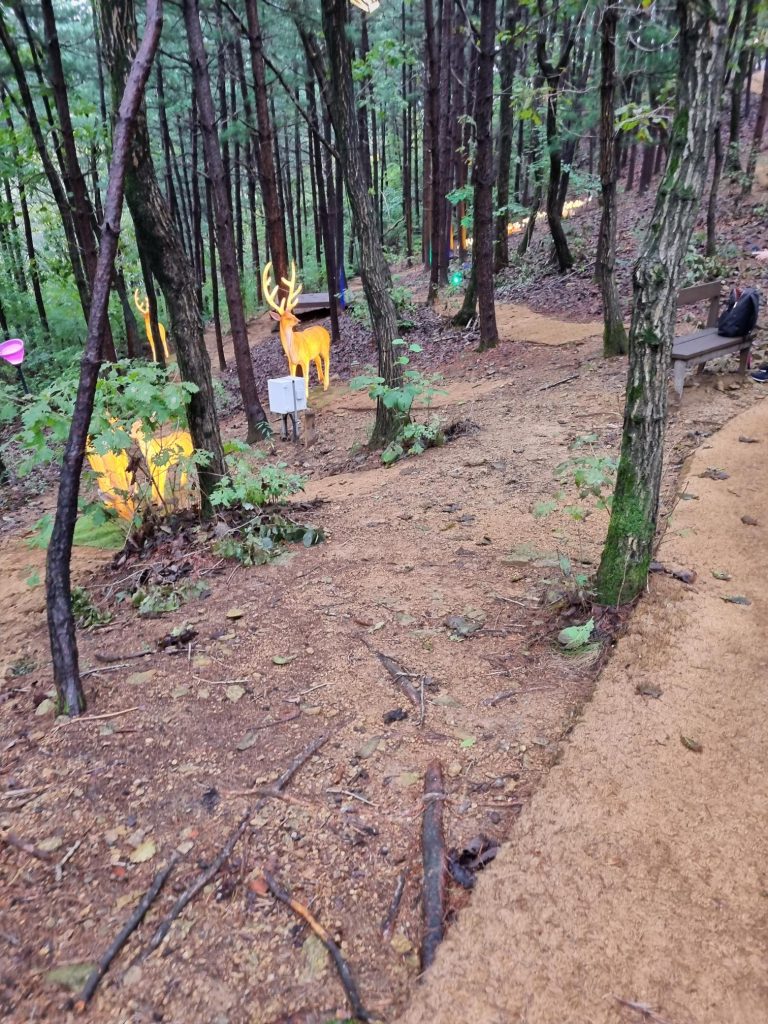
Back to a slightly more surreal, theme park feel, to the suspension bridge which was over the valley where the battle took place and is now inhabited by illuminated (literally) by wildlife, mushrooms and a replica white tiger. All that being said, the bridge was very splendid.


The day after DMZ was grey, and to start with, still slightly grizzly. Another educational day beckoned so, undeterred, we headed out to the find brunch and then the National Museum of Korea. Despite the grizzle it was a warm day so neither of us were with waterproofs or umbrella. As we walked along, a man held out his arm with his umbrella on it and insisted we took it. He simply said “it is raining” and pushed it into my hand. We have noticed this type of kind gesture and ‘caring for others’ respect in Korea a lot. It started the day well.
The main exhibition in the museum covered the evolution of Korea to present day. It was vast! The history of calligraphy and painting was very interesting and it was fascinating to see how the settlement and development of human life within SE Asia mirrored the western hemisphere – so similar and yet with obvious differences – the pottery and tools the same uses but different shapes, rice farming instead of grain. Very interesting and a nice change to the day.
After a lot of museum shuffle we walked via lots of different street scenes – many very similar but some more different – to Dongdaenum Market.
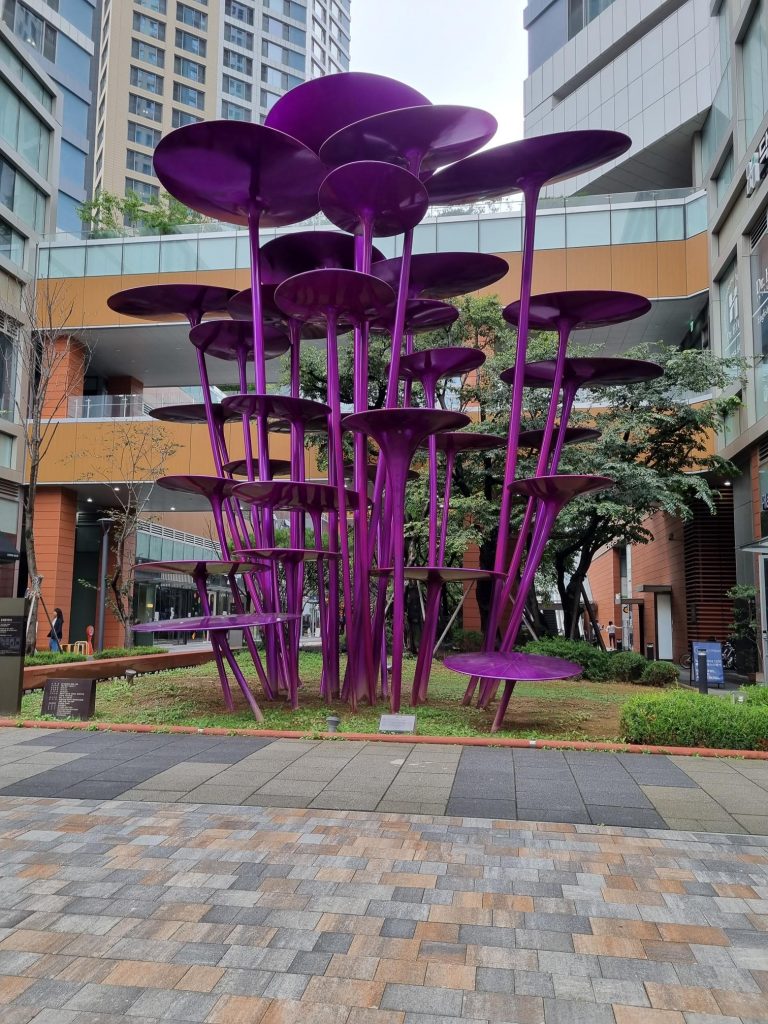
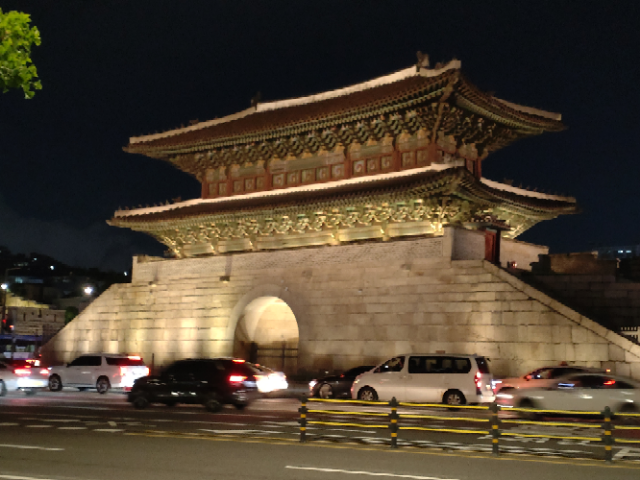
Dongdaemun is reportedly a lively night market but sadly, the market was only just starting up and seemed very small in comparison to Namdaemun market near us so we decided to head back to our digs. However, we did stumble upon the Dongdaenum History Museum which was a fabulous structure and seems to be more of an art and design centre and a very beautiful pagoda in the centre of a road junction.

Day 21 (!) of our travels brought on a totally different learning experience! We had applied on line for our visas for Cambodia a few days beforehand. On receiving them, we found out we had to print two copies each – seems a bit odd as it’s all done electronically, but there you go. Our apartment host came up trumps by pointing us to an ‘unmanned’ print machine in the depths of Seoul Station.
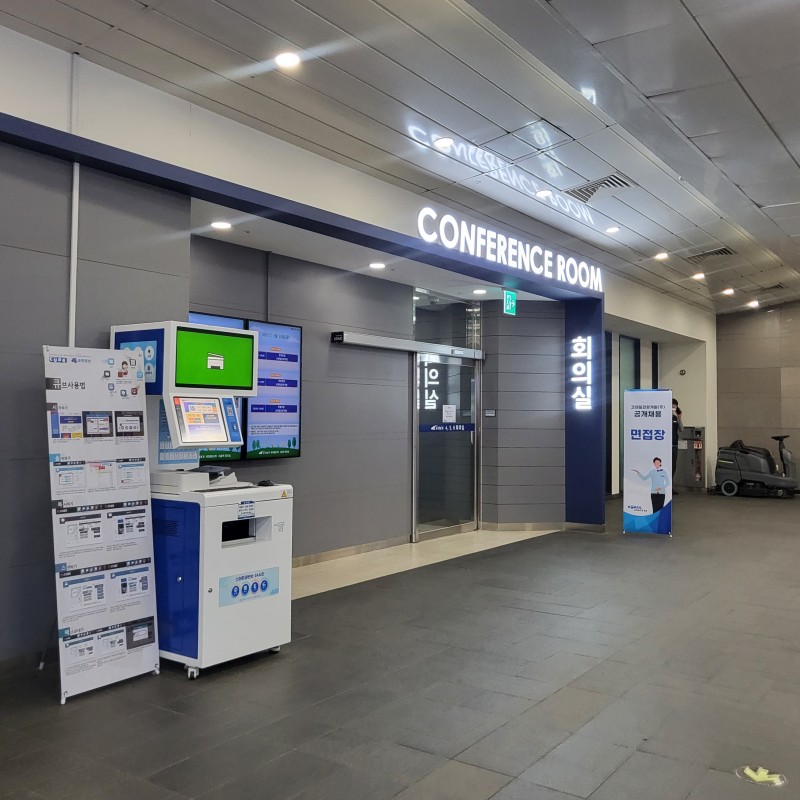
Thankfully, we were able to get instructions (some) in English and print the documents needed, all for the princely sum of £0.74!!! A bargain.
And after that excitement more walking was needed. Chuseok was having an impact on traffic and as the streets were quiet we headed to Bukchon Hanok Village, a traditional Hanok house village actually within Seoul, near to Changdeokgung Palace where we had been earlier in the week. We stumbled on a temple during on our journey and were struck by the topiary and statues alongside the more traditional icons.
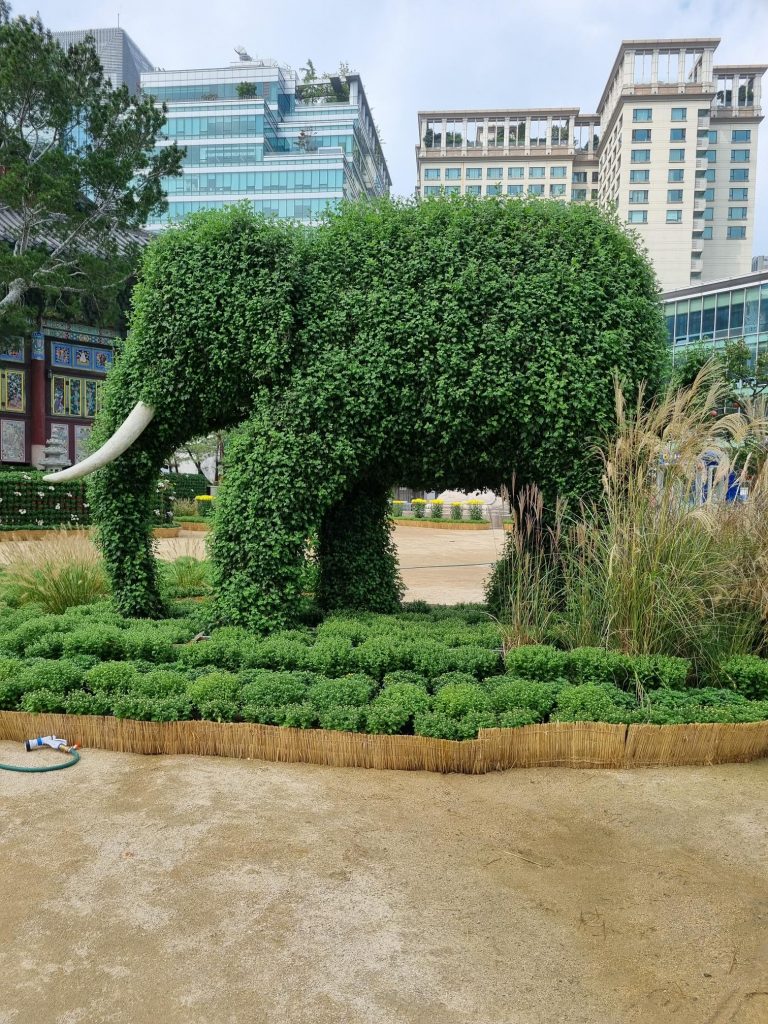

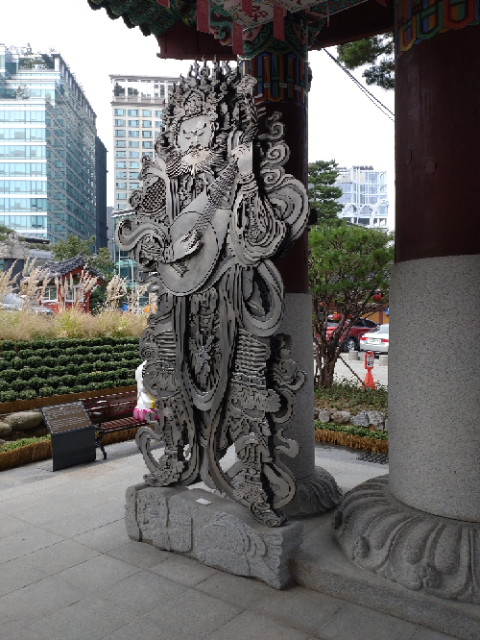
It feels a little incongruous to see such an old building in the centre of so much new development.

Being Chuseok, lots of people were off work and many of the attractions – palaces etc, are free admission during festivals, so everywhere was pretty full of people. However, this didn’t stop us enjoying the Hanok Village – a small enclave of very traditionally built houses with narrow steep alleyways between. Not all the buildings are old though as there were some newer ones under development. It was a very different village to the traditional village we visited in Busan – not so colourful, but perhaps more attractive as the roofline was so interesting.
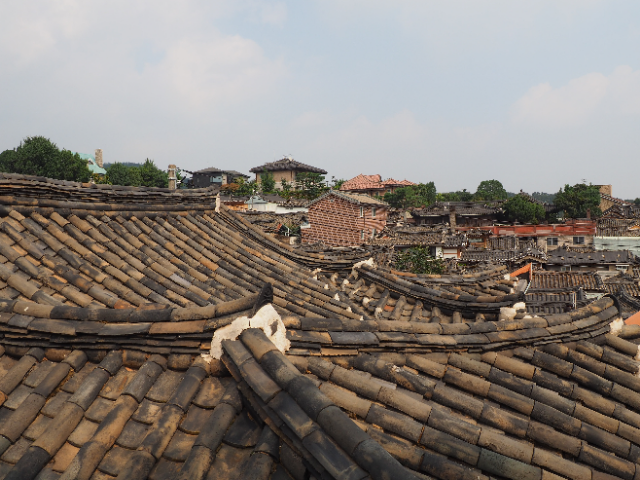
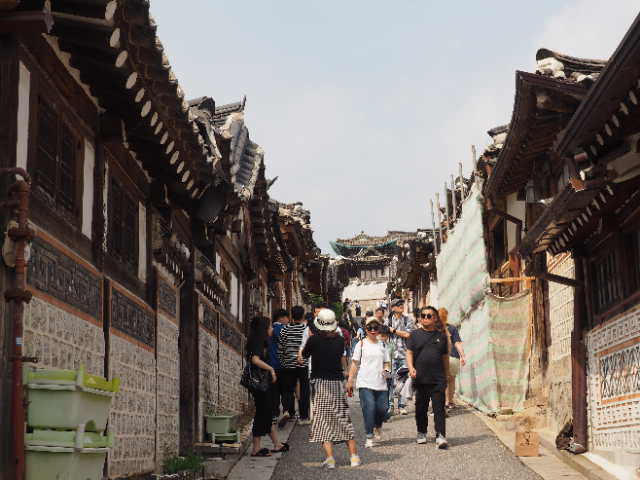

It must be really difficult for the local residents but they seem to make the best of it and there were many cafes and shops for parting tourist with their hard earned cash, including icecream, of course.
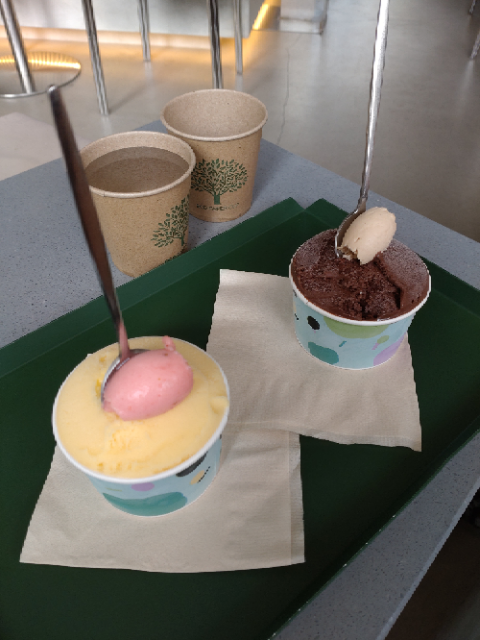
We love the quirkiness of Korea.

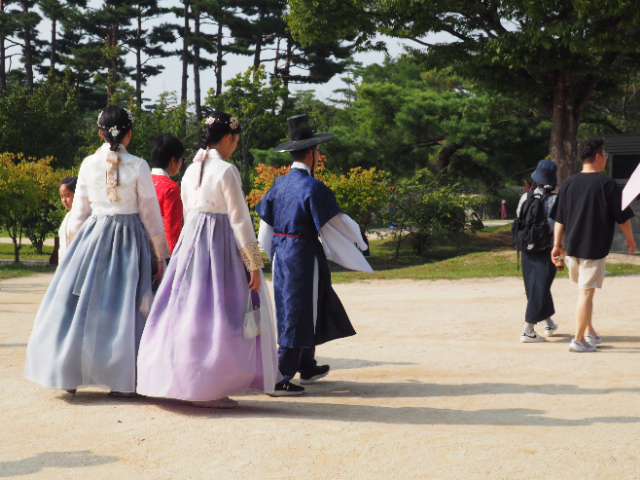
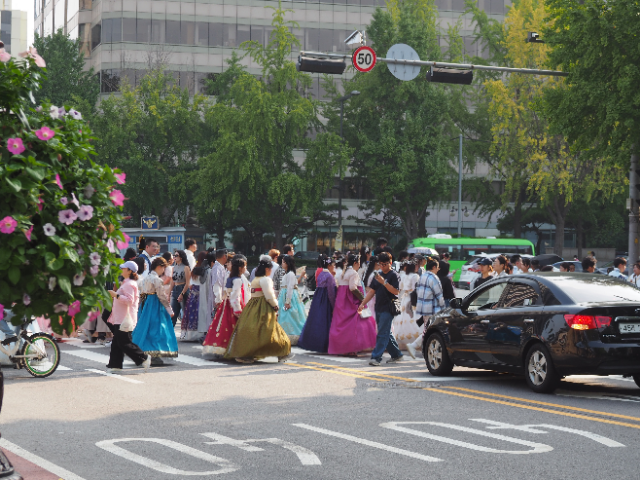
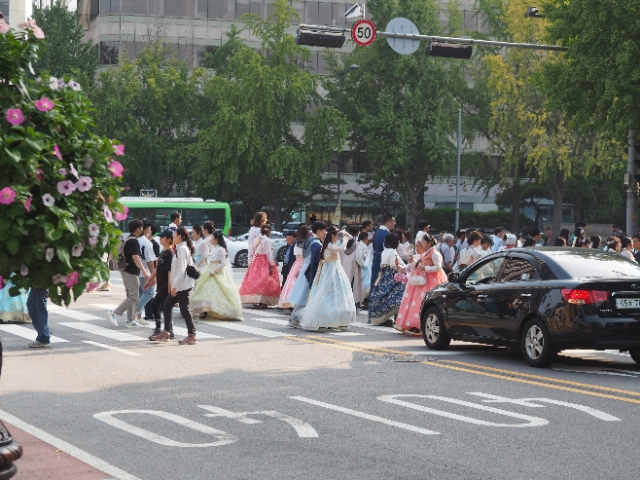
It would seem that the wearing of the Hanbok – the traditional dress of Korea is very popular, in particular with the indigenous population and as well as tourists, as there were many people wearing it, particularly around the village and the nearby palace – also visited (it seemed rude not to..!). We are not sure of the reason for it being so popular, other than a way of showing respect for your history and national pride. However, it made for a colourful, if somewhat crowded, street scene.
We headed back to the apartment and then Itaewon to meet Rosa for dinner and shared a huge plate of beef, prawns and mixed veg.